Eagle Blog

ScanRDI® Rapid Sterility Testing for 503A Compounding Pharmacies

Alternative sterility testing supports regulatory compliance while also directly affecting product release timing, workflow efficiency, and inventory management within compounding pharmacies. At Eagle Analytical, ScanRDI® is the fastest alternative to USP <71>, implemented to support product release for 503A compounding pharmacies operating under USP <797>. 

ScanRDI® enables pharmacies to: 

  • Support product release decisions within 1–2 days, with same-day analytical detection may be possible in certain validated product-specific workflows 
  • Reduce delays between compounding and dispensing  
  • Minimize quarantine time and inventory holding  
  • Improve alignment between testing timelines and assigned beyond-use dates (BUDs) 

What Is ScanRDI®?

ScanRDI® is a non-growth-based sterility testing method that uses solid-phase cytometry to detect viable microorganisms in a sample. 

The method includes: 

  • Membrane filtration  
  • Fluorescent staining of viable cells  
  • Laser-based scanning and detection  

Unlike traditional sterility testing methods described in USP <71>, ScanRDI® does not rely on microbial growth. This eliminates the need for extended incubation periods and allows analytical detection within hours following sample preparation, with final reported results typically available in 1–2 days 

Because of this, ScanRDI® is used to support product release decisions, supporting timely evaluation of sterility prior to dispensing compounded sterile preparations. 

Quantified Speed Advantage: Traditional vs. ScanRDI®

Method
Typical Time to Result
Release Impact
USP <71>
14 days
Long quarantine, delayed release
Celsis®
5-6 days
Moderate acceleration
BacT/ALERT®
5-6 days
Moderate acceleration
ScanRDI®
1-2 days (same-day possible)
Supports timely product release decisions

What Needs to Be Tested?

Sterility testing is required for specific compounded sterile preparations (CSPs), including: 

  • Category 2 CSPs when sterility testing is required based on assigned beyond-use dates and compounding conditions 
  • Category 3 CSPs, where sterility testing is generally required to support assigned beyond-use dates 

These requirements align with USP <797> guidelines and are essential for ensuring patient safety and regulatory compliance. 

Regulatory Considerations for Rapid Sterility Testingre

Rapid sterility testing methods such as ScanRDI® may be used when properly validated for the specific product and intended use. 

Key requirements include: 

  • Product-specific method suitability testing  
  • Demonstration that the alternative method is suitable and comparable to USP <71> for the intended product 
  • Complete and traceable documentation  

ScanRDI® validation is performed in accordance with USP <1223> Validation of Alternative Microbiological Methods. 

Eagle Analytical supports compounding pharmacies through method suitability, validation, and implementation, ensuring alignment with USP <797> and State Board of Pharmacy expectations. 

Important Considerations for ScanRDI® Sterility Testing

ScanRDI® provides rapid detection of viable microorganisms, but appropriate application is essential. 

Key considerations include: 

  • Detection does not rely on microbial growth  
  • Positive results may not consistently generate recoverable isolates for species-level identification 
  • Product compatibility must be confirmed through method suitability testing  

Frequently asked questions: ScanRDI® and Rapid Sterility Testing

Eagle Analytical’s position is supported by over 20 years of experience working with the ScanRDI® system, with a focus on applying rapid sterility testing methods within 503A compounding environments under USP <797>. 

Eagle Analytical supports compounding pharmacies through: 

Over 20 years of experience supporting sterility testing for compounded sterile preparations, including Category 2 and Category 3 CSPs. 

Consistent Turnaround for Release Testing: 

  • Results in 1–2 days  
  • Turnaround aligned with pharmacy dispensing workflows  
  • Reproducible timelines across batches  

Scientifically Grounded Method Suitability: 

  • Product-specific method suitability testing  
  • Evaluation of formulation compatibility, including filtration and fluorescence considerations  
  • Determination of appropriate use for ScanRDI®  

Regulatory-Ready Documentation: 

  • Clear and structured Certificates of Analysis (COAs)  
  • Documentation designed for traceability and audit readiness  
  • Alignment with USP <797> requirements 

The best sterility testing method depends on your goals: 

  • Choose USP <71> for traditional, growth-based confirmation  
  • Choose rapid growth-based methods for moderate acceleration  
  • Choose ScanRDI® when rapid confirmation of sterility is required to support product release timelines 

For organizations looking to reduce release time from weeks to days, ScanRDI® offers a clear advantage. 

Rapid sterility testing methods such as ScanRDI® are used to support product release decisions, not to establish or extend beyond-use dates (BUDs). 

Under current regulatory expectations, BUD assignment for compounded sterile preparations must follow USP <797> requirements, which may include sterility testing such as USP <71>, along with stability data and risk-based considerations. 

Appropriateness of ScanRDI® as a Validated Alternative Rapid Microbiological Method
On May 6, 2026, the Eagle Analytical team met with the Louisianna Board of Pharmacy to support pharmaceutical clients by pioneering the implementation of ScanRDI® testing in sterile compounding.
 
Eagle values transparency and collaboration- foundational features underlying analytical testing.
 
We prioritize clients and provide tools to conserve patient safety. Eagle’s mission focuses on clarity- elucidating innovative transitions & science-based technology, navigating pressing discussions, and characterizing data-driven protocols reflecting operational needs- the epitome of advocacy.
 
We aim to continue aseptic services for pharmacies & healthcare enterprises through scientific guidance, regulatory compliance, and industry-related advocacy.
 
Eagle is committed in pursuit of the extra mile- our client’s trust in us is a responsibility we take seriously. We remain dedicated to protecting it through quality, transparency, & service. 
ACHC Partnership Announcement

Eagle Analytical Services is pleased to announce its partnership with ACHC, The Accreditation Commission for Health Care. Through this partnership, ACHC-accredited pharmacies and facilities have access to Eagle’s full range of laboratory, consulting, and engineering services, with special terms and pricing available for compliance audits.

Eagle Analytical supports the pharmaceutical compounding industry and services include analytical chemistry and microbiological testing, such as stability studies, sterility testing, and endotoxin testing, as well as cleanroom and hazardous drug certification, aseptic training, equipment qualification, process validation, compliance audits, regulatory response, remediation, and more.

This partnership reflects Eagle’s continued commitment to helping healthcare organizations strengthen compliance, support patient safety, and navigate the accreditation and inspection process more efficiently.

About ACHC

ACHC is a nationally recognized accrediting organization that supports healthcare providers through accreditation, education, regulatory resources, and survey processes designed to promote quality, compliance, and patient-centered care.

ACHC offers accreditation and certification programs across a broad range of healthcare settings, including pharmacy, compounding pharmacy, clinical laboratory, home health, hospice, hospital, ambulatory care, and more. Programs are created in consultation with industry experts to ensure relevance, value, clarity, and integrity.

Protein Characterization

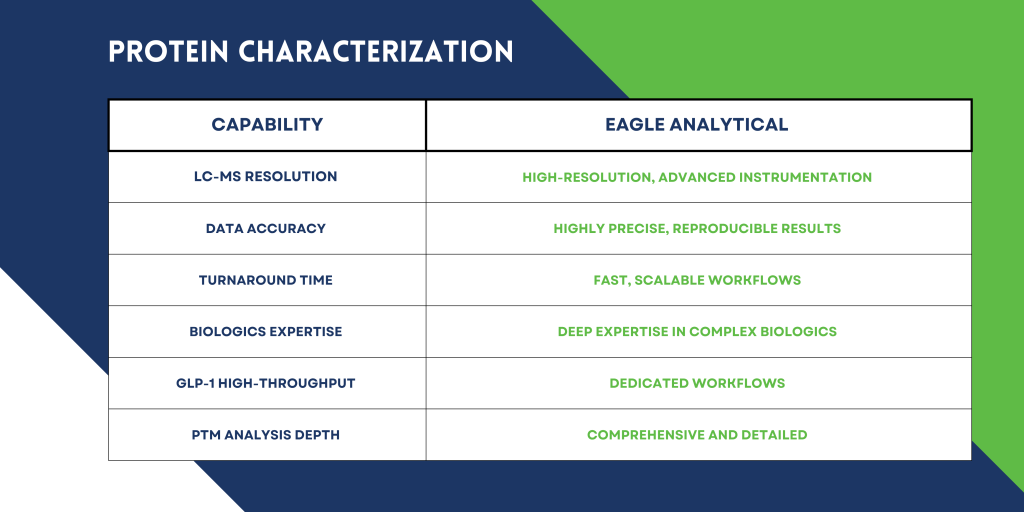
Advanced LC-MS Protein Characterization Services

Eagle Analytical provides advanced LC-MS protein characterization services to support biologic development, ensure product quality, and accelerate regulatory compliance. Our team combines deep scientific expertise with state-of-the-art instrumentation to deliver reliable data, actionable insights, and faster project timelines. 

Whether you are developing monoclonal antibodies, peptide therapeutics, or complex biologics, Eagle is your partner for high-resolution protein analysis and comprehensive characterization.

What is Protein Characterization?

Protein characterization is the process of analyzing proteins to understand their structure, sequence, modifications, and functional properties. It is a critical step in biopharmaceutical development, ensuring that biologics meet safety, efficacy, and quality standards. 

Through advanced LC-MS–based workflows, protein characterization provides detailed insights into: 

  • Amino acid sequence and peptide integrity  
  • Post-translational modifications that affect protein stability and activity  
  • Molecular weight and structural variants for monoclonal antibodies, antibody-drug conjugates, and complex biologics  
  • Protein quantity and composition for regulatory compliance and research validation  

Protein characterization is essential for: 

  • Accelerating biologic development  
  • Ensuring batch consistency and product quality  
  • Supporting regulatory submissions with high-confidence data  

Eagle Analytical combines state-of-the-art instrumentation with deep scientific expertise to deliver high-quality, reproducible protein characterization results that support every stage of drug discovery, development, and manufacturing. 

Why Choose Eagle Analytical for Protein Characterization

Eagle Analytical delivers a precise, scalable, and reliable approach compared to typical analytical providers. Our services are designed to meet the complex needs of biopharmaceutical research and development, helping clients advance their programs with confidence. 

Eagle Analytical provides better accuracy, faster results, and complete support across all protein characterization workflows. 

Our Protein Characterization Services

Peptide Mapping and Sequence Confirmation 

Eagle uses LC-MS to deliver accurate peptide mapping and sequence confirmation. Detect sequence variants, verify amino acid sequences, and ensure batch consistency. 

GLP-1 Peptide High-Throughput Characterization 

Our high-throughput workflows enable rapid analysis of GLP-1 peptides and analogs, confirming peptide identity, purity, and sequence integrity. This solution accelerates discovery and development timelines. 

Protein Identification and Quantitation 

Accurate identification and quantitation confirm sample composition and protein expression. Eagle provides reproducible and precise measurements for research, process development, and regulatory submissions. 

Intact Protein Analysis 

Evaluate molecular integrity and heterogeneity for monoclonal antibodies, antibody-drug conjugates, and other complex biologics. Determine molecular weight, detect structural variants, and assess drug-to-antibody ratios. 

Post-Translational Modification Analysis 

Identify and characterize PTMs such as glycosylation, oxidation, deamidation, and phosphorylation. Detailed PTM analysis ensures protein stability, function, and therapeutic performance. 

Get Started with Eagle Analytical

Accelerate your biologic development with Eagle’s expert protein characterization services. Contact us today to discuss your project and discover how our high-resolution LC-MS workflows can deliver precise, actionable results. 

Peptide Mapping for Protein Characterization

Understanding Peptide Mapping in Protein Characterization

Peptide mapping is one of the most powerful analytical techniques used in protein characterization and biopharmaceutical analysis. It helps scientists confirm a protein’s identity, primary sequence, and structure. It does this by enzymatically digesting the protein into peptide fragments, which are then separated and analyzed in detail. 

Peptide mapping is vital for biotherapeutic development, quality control, and regulatory compliance. It helps ensure that proteins in pharmaceuticals maintain the correct structure and functionality throughout the product lifecycle. 

What Is Peptide Mapping?

Peptide mapping is a widely used analytical method for confirming a protein amino acid sequence and identifying potential structural changes. The technique combines enzymatic digestion with liquid chromatography and mass spectrometry to generate and analyze peptide fragments. 

The process uses specific proteolytic enzymes to digest proteins into smaller peptides. These peptide fragments are then separated using liquid chromatography (LC) and analyzed using high-resolution mass spectrometry (MS). 

By comparing the resulting peptide profile with the expected amino acid sequence, scientists can confirm correct protein expression and detect structural variations. These variations may include sequence mismatches, post-translational modifications, or degradation of products that could affect a protein’s safety, stability, or biological activity. Because of its high precision and sensitivity, peptide mapping is widely regarded as the gold standard technique for protein characterization. It is extensively used in biologic drug development, quality control testing, and regulatory evaluation of biopharmaceutical products. 

Why Peptide Mapping Matters in Biopharmaceutical Development

Modern biotherapeutics such as monoclonal antibodies, recombinant proteins, and vaccines are complex molecules. Even small structural variations can influence safety, stability, biological activity, and therapeutic effect.

Peptide mapping helps scientists: 

  • Confirm protein identity by verifying the amino acid sequence 
  • Detect post-translational modifications (PTMs) such as oxidation, deamidation, or glycosylation 
  • Assess product consistency across manufacturing batches 
  • Monitor degradation and other structural changes during storage or processing 
  • Support regulatory submissions and comparability studies 

Because regulatory agencies require detailed structural characterization of biologics, peptide mapping is a critical component of analytical characterization strategies throughout the drug development lifecycle.

How Peptide Mapping Works

Although the workflow can vary depending on the protein and analytical goals, peptide mapping typically follows several key steps. 

  1. Protein Digestion

First, the protein sample is digested with a site-specific protease, most commonly trypsin. This enzyme cleaves the protein at predictable amino acid residues, producing a set of peptide fragments that represent the original protein sequence. 

  1. Peptide Separation

The resulting peptides are separated using high-performance liquid chromatography (HPLC) or ultra-performance liquid chromatography (UPLC). This step isolates individual peptides based on their physiochemical properties, allowing them to be analyzed individually 

  1. Mass Spectrometry Analysis

Each peptide is then analyzed using high-resolution mass spectrometry. This method measures the precise mass of the peptides and their fragments. Providing detailed information about the peptide sequences and potential modifications. 

  1. Data Interpretation

Finally, specialized bioinformatics software and expert scientists compare the peptide data with the expected protein sequence. This confirms protein identity and reveals any structural variations or modifications. 

When performed using high-resolution instrumentation and advanced data analysis, peptide mapping provides comprehensive insight into protein structure, sequence integrity, and overall product quality.

What Sets Eagle Apart in Peptide Mapping

Peptide mapping requires more than advanced instrumentation; it demands scientific expertise, optimized workflows, and reliable data interpretation to deliver meaningful insights. Eagle’s peptide mapping services are designed to deliver accurate protein characterization to support the entire biotherapeutic lifecycle.

Advanced Mass Spectrometry Capabilities 

Eagle utilizes state-of-the-art high-resolution mass spectrometry platforms combined with optimized chromatographic separation techniques. This approach enables: 

  • High peptide sequence coverage 
  • Sensitive detection of low-level modifications 
  • Accurate mass measurement and fragmentation analysis 

These capabilities enable comprehensive structural characterization of complex proteins and biologics. 

Deep Expertise in Protein Characterization 

Eagle’s team of scientists brings extensive experience in biotherapeutic analysis, peptide mapping workflows, and mass spectrometry data interpretation. Their expertise helps translate complex analytical data into clear, actionable insights for clients. 

This scientific depth is particularly valuable when investigating: 

  • Post-translational modifications (PTMs) 
  • Sequence variants 
  • Product degradation pathways 
  • Biosimilar comparability studies 

Robust and Reproducible Analytical Workflows 

Consistency is critical in protein characterization. Eagle employs validated peptide mapping methods and optimized digestion workflows to ensure reproducibility and reliability across samples and studies. 

These workflows are designed to support: 

  • Early-stage development 
  • Process development and comparability studies
  • Product characterization for regulatory submissions 
  • Quality control and stability studies 

Clear, Actionable Data Interpretation 

Beyond generating analytical data, Eagle focuses on delivering clear scientific interpretation and reporting. Detailed reports help clients understand structural findings, potential risks, and their implications for product development or manufacturing. 

This approach allows organizations to make informed decisions with confidence. 

Supporting the Entire Biotherapeutic Lifecycle 

Eagle’s peptide mapping services support protein characterization from early discovery through commercial manufacturing. Whether confirming protein identity, assessing structural changes, or supporting regulatory documentation, Eagle provides the analytical expertise needed to ensure product qualityconsistency, and integrity. 

Exploring Alternative Sterility Testing Methods: A Q&A with Eagle Experts.

We’re proud to share that Eagle’s experts were recently interviewed by American Pharmaceutical Review magazine for an in-depth discussion on alternative sterility testing methods. The article was published in the September issue of American Pharmaceutical Review.

Below, you can read the full feature and explore insights from our team on evolving sterility testing approaches and future industry trends.

What are some of the key challenges in adopting rapid sterility testing methods over the traditional USP <71> approach within the pharmaceutical industry?

“Traditional” methods are viewed as the gold standard, highly recognized, widely regulated, and backed by decades of acceptance, which leaves little external pressure to move away from them. On the other hand, adopting rapid methods requires significant investment in new technologies, extensive validation to meet regulatory expectations, and overcoming cultural hesitation to abandon a well-established approach. Moreover, as we explore rapid methods more deeply, it becomes clear they are not a one-size-fits-all solution. Each comes with its own strengths and drawbacks, and because they are designed to be faster and more efficient, they often become more selective in their application.

How can method suitability testing help mitigate risks of false results or incompatibilities when switching to faster sterility assays for novel formulations?

Method suitability testing serves as a critical checkpoint to ensure that a sterility test is truly reliable for a given product. Different drug products can have unique properties such as viscosity, color, pH, or antimicrobial activity that may interfere with the sterility test and either mask contamination or generate misleading outcomes. By performing method suitability, laboratories confirm that the test can detect potential contaminants in the presence of the actual product, rather than just in a clean growth medium.

This step is critical when transitioning to newer or faster assays, as it minimizes the risk of false negatives (contamination being missed) or false positives (contamination appearing where none exists). In other words, it ensures that the chosen method is both accurate and compatible with the product’s characteristics, building confidence in the results and supporting regulatory expectations for patient safety. 

How do recent updates in USP <797> and USP <1223> affect the validation and acceptance of rapid sterility testing technologies, and what requirements must be met for regulatory compliance?

Recent revisions to USP <797> and USP <1223> clarify how rapid sterility tests can replace the traditional USP <71> sterility test, provided it is proven that the alternative is at least equivalent (non-inferior) and fit for its intended use. In other words, if the rapid method is validated per <1223> and implemented within a compliant quality system per <797>, it can be used it in place of <71>. There must be however, A <1223>-aligned validation that includes IQ/OQ/PQ, accuracy, precision, specificity/selectivity, sensitivity/LOD, robustness, and equivalence/non-inferiority vs. <71>, plus method suitability for each product.

What are the current FDA and USP expectations for alternative rapid sterility methods, and how can organizations demonstrate equivalency or superiority to USP <71>?

FDA does allow rapid and alternative microbiological methods for in-process, and finished-product release, including sterility, if you demonstrate the method is equivalent or better than the conventional method. You would also need to validate accuracy, sensitivity, specificity, and reproducibility per 21 CFR 211.  USP <797> states that for sterility testing you may use USP <71> or a validated alternative that is non-inferior to <71>, with validation aligned to USP <1223>, which in turn provides the playbook for selecting, validating, and justifying alternative and rapid methods, emphasizing qualification with the actual product and demonstration of equivalence or superiority to the compendial method.

What are the main differences between rapid sterility testing platforms such as ScanRDI®, BacT/Alert®, and Celsis®, and what advantages does each bring for different product types?

Each has different detection principles, and their strengths depend on the type of product being tested.


ScanRDI® (bioMérieux) uses solid-phase cytometry with fluorescent staining to directly detect individual microbes captured on a membrane. It is non-growth-based and can deliver actionable sterility decisions in ~4 hours. That makes it a strong fit for short  filterable aqueous products with a short BUD.

BacT/ALERT® (bioMérieux) is an automated growth system that monitors CO₂ production in inoculated culture bottles via a colorimetric sensor. It is highly versatile across complex matrices, including cell & gene therapy and products where filtration is impractical or organism recovery is challenging. It can yield results in 7 days.

Celsis® (Charles River) employs amplified ATP bioluminescence after enrichment to flag contamination. It can yield sterility results in 6-7 days. It’s a strong option for a wide range of filterable and non-filterable products.

How does the ScanRDI® system achieve 1-2 day sterility results, and what types of pharmaceutical products can it effectively test?

ScanRDI® utilizes solid-phase cytometry principles to detect viable microorganisms. Unlike traditional methods, it is not growth-based, allowing for rapid detection. The process begins by filtering an appropriate volume of the product through a 0.45 µm membrane. The membrane is then rinsed to eliminate any residual substances that could cause autofluorescence. Viable cells retained on the membrane are stained using proprietary reagents and incubated. These reagents interact specifically with enzymes present in viable cells. This enzymatic activity transforms one of the reagents into a fluorescent compound, causing the viable cells to fluoresce. The prepared membrane is placed into the ScanRDI® instrument, which performs a laser scan across the entire surface. The software flags all fluorescent events—these may include viable cells or autofluorescent particles—and records their X-Y coordinates.

Finally, the operator reviews these coordinates under a fluorescence microscope to distinguish true viable cells from background particles or artifacts.

What new advancements or future trends are emerging in the field of rapid sterility testing, and how might they further shorten turnaround times or expand testing capabilities for complex biopharmaceutical products?

New advancements in rapid sterility testing are focused on reducing turnaround times from weeks to hours or days by leveraging technologies like nucleic acid amplification, bioluminescence and nanopore sequencing. These innovations help accommodate the limited shelf-life of complex biopharmaceuticals, such as cell and gene therapies in addition to conventional sterile pharmaceutical products. Future trends include greater automation, machine learning for faster analysis, and new technologies for in-process and real-time monitoring.

Illustration of USP Endotoxin Testing using recombinant reagents rCR and rFC as sustainable alternatives to LAL-based BET methods.
A New Era for Endotoxin Testing: USP <86> Introduces Sustainable Recombinant Alternatives to LAL

Today, USP <85> continues to serve as the gold standard for Bacterial Endotoxin Testing (BET), relying exclusively on Limulus Amebocyte Lysate (LAL) derived from the blood of the Atlantic Horseshoe Crab (Limulus Polyphemus). While detection methods varied, the reagent initiating the cascade reaction was always LAL. This dependence on a single-source, regionally limited raw material raised concerns about sustainability and supply chain reliability.

LAL is extracted from the horseshoe crab’s blood, primarily sourced from the Northeastern United States. However, environmental challenges such as overharvesting (for bait), habitat disturbance, climate change, and pollution threaten the crab population. These factors jeopardize the consistent availability and performance of LAL, posing risks to the integrity of BET results.

In response, conservation efforts have emerged, including regulatory oversight, habitat protection, and aquaculture initiatives. Simultaneously, the pharmaceutical industry has embraced the Three R’s Principle—Replacement, Reduction, and Refinement—by developing non-animal dependent reagents with comparable efficacy. Although recombinant alternatives have existed for over two decades, compendial recognition was only recently achieved.

In November 2024, USP announced the publication of USP <86>, officially released in May, introducing recombinant reagents for BET. This marks a significant milestone, as both USP <85> and USP <86> are now approved for endotoxin testing.

Illustration comparing the endotoxin detection pathways of traditional LAL methods and recombinant reagent–based methods.

USP <86> features two recombinant reagents: Recombinant Cascade Reagent (rCR) and Recombinant Factor C (rFC). These are genetically engineered using recombinant DNA to produce the necessary protein complexes for endotoxin detection. The rCR pathway mirrors the kinetic chromogenic LAL method, incorporating Factor C, Factor B, and a pro-clotting enzyme. In contrast, rFC utilizes only Factor C and a fluorogenic substrate, streamlining the detection process.

The rCR reagent offers a seamless transition from LAL, requiring minimal method modification. It also eliminates β-glucan interference, enhances robustness, and reduces lot-to-lot variability. Meanwhile, rFC, though structurally distinct, promises faster reaction times due to its simplified pathway and fluorescence-based detection. The adoption of USP <86> reflects growing confidence in recombinant technology to deliver reliable, sustainable BET solutions. It addresses key concerns:

REPLACE. Substitutes animal-derived LAL with recombinant reagents (rCR and rFC).
REDUCE. Expands market options, decreasing reliance on LAL.
REFINE. Minimizes animal impact by offering non-animal alternatives.

Moreover, recombinant reagents mitigate supply chain vulnerabilities and improve consistency. Despite industry hesitation to shift from a 40-year reliance on LAL, USP recognition and ongoing research are expected to bolster confidence in USP <86>. In time, recombinant technology may not only match but surpass LAL usage and potentially replace it entirely.

FDA Investigator’s Manual

We’ve added a comprehensive FDA Handbook to our website to help you better understand FDA rules, compliance expectations, and industry best practices. Whether you work in healthcare, pharmacy, or regulatory affairs, this guide gives you practical information to help you stay aligned with current FDA standards.

What’s included:

  • Administrative guidance

  • Notes, records, and documentation

  • Regulatory procedures

  • Sampling and inspections

  • Import guidance

  • Recall activities

  • Investigations

  • Public health collaboration

  • Safety practices

  • Appendix for reference

The handbook is the Investigations Operations Manual (IOM), which is the FDA’s main guide for how field investigations are performed. The IOM sets the rules that FDA staff follow to ensure investigations are done correctly, consistently, and in support of public health.


Download FDA Handbook


Lessons Learned in Interpreting and Operationalizing USP 795 and USP 797 Updated Requirements

When industry veterans gathered in Boston for the 2025 Compounding Pharmacy Compliance (CPC) Conference, all eyes were on one of the most anticipated sessions of the year — a presentation by Dr. Ross Caputo, President & CEO of Eagle.

Former IVT Speaker of the Year (2021), Dr. Caputo returned to the CPC stage not just with insight, but with experience. His presentation, titled “Lessons Learned in Interpreting and Operationalizing USP 795 and 797,” was less about theory — and more about what actually works.

What’s Changed — and Why It Matters

The recent updates to USP <795> and <797> have challenged the compounding world to raise the bar. It’s no longer enough to “follow SOPs.” Now, compliance requires deep integration of training, documentation, facility control, and evidence-based testing.

From beyond-use dating (BUD) to aseptic simulation, pharmacies are expected to not just know the standards — but to prove them operationally.

“There’s a difference between reading a regulation and living it,” Dr. Caputo told the room.

The Designated Person: Not a Title, a Responsibility

One of the most misunderstood shifts? The role of the Designated Person (DP). Many assume it’s just the pharmacist-in-charge. Not quite.

According to USP, the DP is anyone — or a team — formally accountable for compounding operations, environmental control, and regulatory adherence. Dr. Caputo urged attendees to define DP roles functionally, not by job titles. And most importantly? Document everything.

Hazardous Drugs, Higher Stakes

With USP <800> now fully applicable, hazardous drug (HD) compounding must meet a higher standard. Negative pressure rooms, proper venting, and rigorous wipe sampling aren’t optional — they’re expected.

Dr. Caputo shared a common pitfall: facilities that think passing a certification once means they’re in the clear. The truth? “If you’re not monitoring airflow or exposure routinely, you’re just hoping for compliance.”

Potency ≠ Stability

Here’s where it gets technical — and where many pharmacies fall short.
A drug holding potency over time does not automatically meet stability requirements under the new standards. Category 3 compounded sterile preparations (CSPs) now demand:

  • Stability-indicating test methods

  • Container-closure integrity

  • Particulate testing

  • AME (antimicrobial effectiveness) for aqueous formulas

And those tests? They must be run on the exact formulation, container, and components you’re actually using. No substitutions.

Categories 1, 2, 3 — Not Just New Labels

Gone are the days of “low-, medium-, high-risk” compounding. The USP revisions now classify CSPs as Categories 1, 2, or 3, with levels based on environmental control, garbing, testing, and procedural rigor — not just how complex the product is.

This change impacts beyond-use dating, monitoring schedules, and garbing protocols. And yes — it’s a heavy lift.

“If you’re treating a Category 3 CSP like a Category 1, you’re gambling with compliance,” Dr. Caputo cautioned.

Media-Fill and Smoke Studies: Simulation Is the Standard

Off-the-shelf media-fill kits? Often inadequate.

Media-fill testing must fully simulate your facility’s aseptic process — duration, personnel, manipulations, interruptions, the whole picture. Dr. Caputo emphasized that your media-fill should tell your story, not just meet a checklist.

And as for smoke studies — video recording is now standard. Each compounding process (vials, IV bags, syringes) should be assessed individually.

The Bottom Line: Compliance Is a Living System

Throughout the presentation, one theme came through loud and clear: data without action is meaningless.

Environmental results, personnel requalifications, SOP updates, deviations — these aren’t just records to keep. They’re opportunities to identify trends, anticipate risks, and continuously improve.

“You don’t fail an audit because you had an excursion,” Dr. Caputo said.
“You fail it because you didn’t know why it happened.”

What Comes Next?

As states stagger in how they adopt USP standards, pharmacies must prepare for the most stringent interpretation. Some will audit for <795> compliance; others may enforce <800> with zero grace. Dr. Caputo encouraged facilities to stay ahead by creating internal standards that exceed the baseline — not just meet it.

At Eagle Analytical, our mission remains unchanged: to help compounding pharmacies not just survive regulation changes, but lead through them.

Whether it’s stability studies, media-fill testing, facility qualification, or SOP development, our team is here to support your compliance — every step of the way.


📞 Need help navigating the new USP standards?
Visit eagleanalytical.com or call us at 800.745.8916


Relevant Services
✓ Stability Testing for BUD Validation
✓ Smoke Studies & Video Documentation
✓ USP <800> Containment Planning
✓ Custom SOPs & QA Consulting

AzPA Convention, 06/12-06/15
Be in the room for candid conversations and hear about the trends shaping the next decade of pharmacy. Eagle would love to see you there! 

From capsules to curriculum, reimagined and resilient, AzPA’s Annual Convention will debut a new fearless experience for every professional in pharmacy.

Event Information